

You've got a notice drafted, the tenant hasn't paid, and now the part that can save or sink the file is the proof of service. In Maple Ridge, that usually means a basement suite in Albion, a townhome in Silver Valley, or a rental in Cottonwood where the paperwork looked fine until someone asked, “How do you know it was served?” British Columbia's RTB-34 is the province's official Proof of Service Notice to End Tenancy and Written Demand to Pay Utilities form, and the current provincial listing shows it as RTB-34 with a June 2025 PDF version, because service records are evidence in tenancy enforcement, not optional extras (provincial RTB-34 form).
Why Maple Ridge Landlords End Up Needing the RTB-34
A landlord calls after lunch from a duplex near Kanaka Creek. The tenant has ignored a notice to end tenancy, the move-out date is approaching, and the landlord has just realised the problem isn't the notice, it's proving service. That's the point where RTB-34 stops being a piece of admin and becomes the record that holds the whole file together.
The Residential Tenancy Branch treats service records as evidence because a notice can unravel if you can't show it was delivered properly. In practice, that means the landlord may have done everything else right and still lose ground if the proof is vague, incomplete, or missing. The form exists to document that the document was served before the landlord moves ahead with a remedy, and that matters whether the rental is a basement suite in Albion or a newer townhome in Silver Valley.
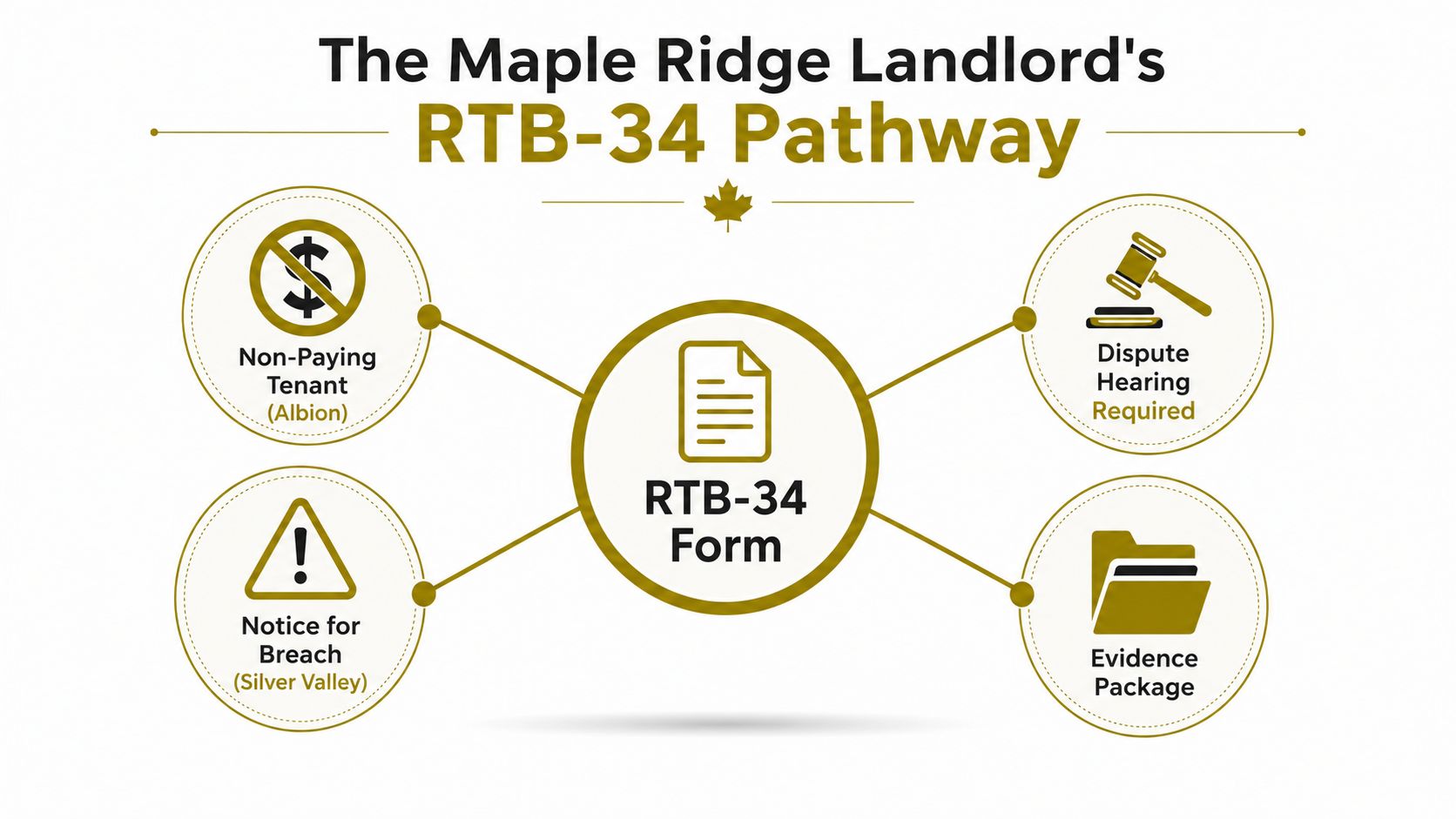
Why the paper trail matters here
Maple Ridge rentals are often small, close-contact arrangements. A landlord might live upstairs, manage a suite from the same building, or rely on a property manager to serve a notice when the relationship has already gone tense. In those situations, nobody wants a hearing to turn into a memory contest.
Practical rule: if service is going to be challenged, the RTB-34 needs to read like a clean chronology, not a rough note scribbled after the fact.
The provincial form list puts RTB-34 alongside other Residential Tenancy Branch forms, which reinforces that it's a standard government document, not a custom notice. That standardisation is what helps when timelines get questioned later. If you're dealing with the wider tenancy rules behind the notice itself, the BC Residential Tenancy Act explained article is a useful companion read.
For tenants, the service issue often comes up at the worst possible time, after stress has already escalated. If the file is drifting toward eviction, a practical reminder from Select Insurance Group renters advice can help tenants think about the next step while the landlord focuses on preserving the record. In Maple Ridge, I've seen that kind of forward planning matter just as much as the notice itself.
Field-by-Field Walkthrough of the RTB-34 Form
The cleanest way to tackle how to fill out the RTB-34 form is to use one real running example and stay disciplined about the details. Say you're managing a basement suite on 240th Street in Maple Ridge, and you've served a 10 Day Notice to End Tenancy for unpaid rent. The RTB-34 should mirror that exact event, not a vague summary of “a notice.”
Start with the document identity
The first descriptive box needs the document you served. Write the exact notice type, such as 10 Day Notice to End Tenancy for Unpaid Rent, not just “notice” or “eviction paper.” Arbitrators want the RTB-34 to line up with the notice in the file, because an unclear description creates confusion about which timeline you're proving.
For the example suite, a solid entry would read: 10 Day Notice to End Tenancy for Unpaid Rent served on the tenant at the rental unit. That wording does two things, it identifies the document and ties it to the tenancy location. If you served a Written Demand to Pay Utilities instead, name it that way, because the form is designed to support either document.
Match the rental address exactly
Use the full civic address and unit number exactly as they appear on the tenancy agreement. In Maple Ridge, that usually means including the unit, street name, and postal code if the form provides space. Don't shorten the address just because you know the building.
A property manager serving a townhouse in Cottonwood or a suite in West Maple Ridge should treat the address field like a cross-check, not a place to improvise. If the unit number is wrong, the whole service record gets weaker. For a basement suite on 240th Street, write the unit and street information exactly as it appears in the lease file.
Name every person correctly
Enter the legal name of the tenant or tenants served. If there's more than one named tenant, list them all. If you're serving on behalf of a landlord, make sure the landlord's or agent's name is recorded in the correct place, not buried in a note field.
The RTB wants consistency, names on the RTB-34, names on the notice, and names in the tenancy agreement should line up.
That's one of the spots where people get casual and pay for it later. “Chris” is not enough if the tenancy file says Christopher. Use the version that matches the agreement and your other documents.
Choosing the Right Service Method for Your Tenant
Service method changes the whole rhythm of the form. The RTB-34 instructions require the server to record the actual date and local time of service, not an estimate, and if the document was mailed or faxed, the form uses the mailing date or fax transmission date as the service date (RTB-34 instructions summary). That matters because a landlord in a Kanaka Creek duplex may be safer handing the notice directly to the tenant, while a mailed delivery can be fine in a quieter file with better paper trails.
How the service date changes
If you hand the notice to the tenant in person, the date you write is the date of hand delivery. If you leave it with an adult at the rental unit, the service date is still the day you did that. If you mail it, the mailing date becomes the date you record. If you fax it, you use the fax transmission date.
That's not just a technical detail. It changes how the timeline is measured, and service timelines are where many Maple Ridge files go sideways. Personal service is usually the safest option when the relationship is already strained, because there's less room for disagreement about whether the notice was delivered.
Comparing methods at a glance
| Method | Service Date Used | Who Can Serve | Dispute Risk |
|---|---|---|---|
| Personal delivery | Actual date and local time delivered | Landlord, property manager, authorised agent, or process server | Lower when documented well |
| Left with an adult at the rental unit | Actual date and local time left with the adult | Same as above | Moderate, depends on detail quality |
| Regular mail | Mailing date | Same as above | Higher if records are thin |
| Email with written consent | Transmission date | Same as above | Moderate, only if consent is clear |
For the broader timing rules that go with notice periods, the how much notice to end a tenancy BC guide is useful context. The key point here is simple, choose the method that gives you the cleanest proof, not the one that feels easiest in the moment.
Describing the Document, Address, and Server Correctly
This is the section where sloppy wording causes avoidable problems. A landlord in Cottonwood may have served a notice for cause, a West Maple Ridge owner may have served a written demand for utilities, and a property manager may have handled the delivery on the owner's behalf. The form needs those facts stated plainly.
Use the exact document name
Write the document the way it appears in your tenancy file. Notice to End Tenancy is not specific enough if you served a 10 Day Notice to End Tenancy for Unpaid Rent. The RTB-34 should tell the arbitrator what document was served without guessing.
Sample wording for a cause notice at a townhouse could be: Served Notice to End Tenancy for Cause at the rental unit. If the document was a written demand for utilities, use: Served Written Demand to Pay Utilities at the rental unit. That wording keeps the proof tied to the exact step in the file.
Describe the address and the server with precision
The service address should be the full rental unit address, not a general neighbourhood description. “Cottonwood townhouse” does not help when the decision-maker is checking whether the unit in the file matches the unit in the notice. Use the exact civic address and unit number every time.
The server field should name the person who delivered the document, with their full legal name and role. If a property manager served it, write that clearly. A practical entry might be: Jane Smith, property manager authorised by landlord. That's stronger than just a first name or a job title without the person's identity.
If you're building your record around the tenancy file as a whole, the damage deposit rules BC article fits naturally alongside this paperwork. The same discipline applies, match the document to the file, and keep the names and address details aligned.
Common RTB-34 Mistakes That Derail Maple Ridge Hearings
Most RTB-34 failures aren't dramatic. They're boring, which is exactly why they show up in hearings. A landlord thinks the file is fine, then the arbitrator sees a missing local time, a vague document description, or a server section left blank, and the hearing turns into a service dispute.

The mistakes that keep coming up
- Mismatched address: The form says one unit, the tenancy agreement says another. The fix is to copy the address exactly from the lease file before you serve.
- Missing evidence dates: The RTB-34 shows service, but the supporting note or attachment doesn't match. The fix is to record the actual date and local time right away.
- Incorrect service proof: The landlord says the tenant got “the notice” without naming it. The fix is to identify the exact RTB number or title of the document.
- Blank server fields: Nobody signs, or the person who served it isn't identified. The fix is to have the actual server complete and sign the form.
- Wrong signature box: A different person signs because they were “helping.” The fix is simple, the server signs, not whoever has the file open that day.
What the hearing symptom looks like
A sloppy RTB-34 often leads to more than a polite correction. It can mean a hearing adjourned, a notice treated as invalid, or a landlord having to restart the timeline. That's expensive in practice because the tenant stays longer and the landlord loses momentum. The property management Maple Ridge rentals article covers the broader file discipline that helps prevent exactly that kind of setback.
Useful standard: if a field matters for service, fill it in the same day you serve the document, while the details are still fresh.
I've also seen landlords try to “clean up” the form later from memory. That rarely helps. If the file is going to be challenged, the best version is the one created immediately, with the dates, names, and method recorded before the story drifts.
Filing the Completed RTB-34 and Serving the Tenant
Once the form is complete, it doesn't live in isolation. Keep a copy in your own records, and make sure it sits with the notice and any supporting proof, such as mailing confirmation or a service note. If the matter ends up in dispute resolution, that package is what the decision-maker will read against the timeline.
If you want a practical overview of how eviction paperwork is handled more broadly, the guide by FaxZen on eviction notices is a useful reference point. The principle is the same here, the form is only one part of a service chain, and the chain has to hold together.
Filing and serving the record
The RTB-34 is often used as evidence in a dispute file, so keep the completed copy ready with the rest of the tenancy documents. Serve or provide it in the way required for the process you're using, and make sure the tenant has the same version you're relying on. A photocopy or scanned PDF should be part of the landlord's own file.
If you're working through a tenancy in Pitt Meadows or Maple Ridge, that backup copy matters when someone later questions what was served and when. The RTB dispute resolution article is a good companion for understanding how that evidence gets used if the matter proceeds.
Next Steps After Filing and When to Bring in Local Help
If the tenant pays, document it and close the file carefully. If they don't, the RTB-34 becomes part of the evidence trail for the next notice or the next application. Either way, a clean service record gives you options, and a sloppy one creates avoidable delays.

If the file is already messy, or if you're unsure whether the document was served the right way, local help saves time. A practical discussion with a property manager who knows Maple Ridge, Albion, Silver Valley, and Pitt Meadows rental patterns can stop a small service error from becoming a bigger tenancy problem. For anyone weighing outside legal support, landlord and tenant solicitors can also be useful when the file has become more formal than a manager should handle alone.
If you're dealing with an RTB-34, a notice to end tenancy, or a service issue that doesn't feel straightforward, Royal LePage Brookside Realty Property Management can help you sort the file, the timeline, and the next step with local care. Visit Royal LePage Brookside Realty Property Management to talk through your Maple Ridge or Pitt Meadows tenancy situation before the paperwork turns into a hearing problem.