
A move-out in Maple Ridge can feel routine right up until the landlord starts comparing the unit to the move-in photos and the tone changes. A clean townhouse in Cottonwood, a basement suite in Albion, or a 1970s place in West Maple Ridge can all produce very different answers to the same question, what can a landlord deduct from a damage deposit BC. The short answer is that BC law keeps the deposit tied to specific losses, documented costs, and a tight return deadline, not to whatever a landlord feels like charging after a tenancy ends.
The Moment Every Tenant and Landlord Dreads
The key moment usually comes on the driveway, not in a hearing room. Keys are handed back, the last box leaves the suite, and the landlord or property manager walks through with the move-out report in one hand and the move-in condition photos on a phone in the other. That is when the question starts, because the deposit is the tenant's money held for limited purposes, not a general repair budget.
A landlord in British Columbia cannot keep the deposit because the unit needs work. The landlord has to get the tenant's written agreement to deductions or apply for dispute resolution through the Residential Tenancy Branch before withholding anything. If that does not happen within the required window after the tenant gives a forwarding address in writing, the landlord can face a double-deposit problem, which is why timing matters just as much as the condition of the unit.
That tighter process is one reason BC feels different from a lot of other places. A landlord who manages rentals in Maple Ridge knows the deposit conversation usually gets messy over small things, not dramatic ones, and those small things are where paperwork and legal boundaries decide the outcome. For a broader comparison of how BC sits beside other rental markets, the guide on identifying top landlord-friendly states is a useful contrast point, even though BC follows its own rules.
The local basics are set out clearly in damage deposit rules in BC. In a Maple Ridge move-out, the same rule set applies whether the unit is a townhouse in Cottonwood, a basement suite in Albion, or an older place in West Maple Ridge where ordinary wear looks different from a newer build in Silver Valley.
Practical rule: If a charge cannot be tied to a specific item, a specific date, and a specific cost, it is probably weak at an RTB hearing.
Allowable Deductions Under BC Law
A Maple Ridge move-out usually gets tense at the same point every time, the landlord starts sorting real losses from items that just belong to owning a rental. British Columbia keeps damage deposit deductions narrow on purpose, and the rules in Brookside's BC deposit guide line up with what we see in practice at inspections and at the RTB table. A deduction has to fit a recognised category and be supported by proof, because the deposit statement should read like a record of actual loss, not a rough guess.
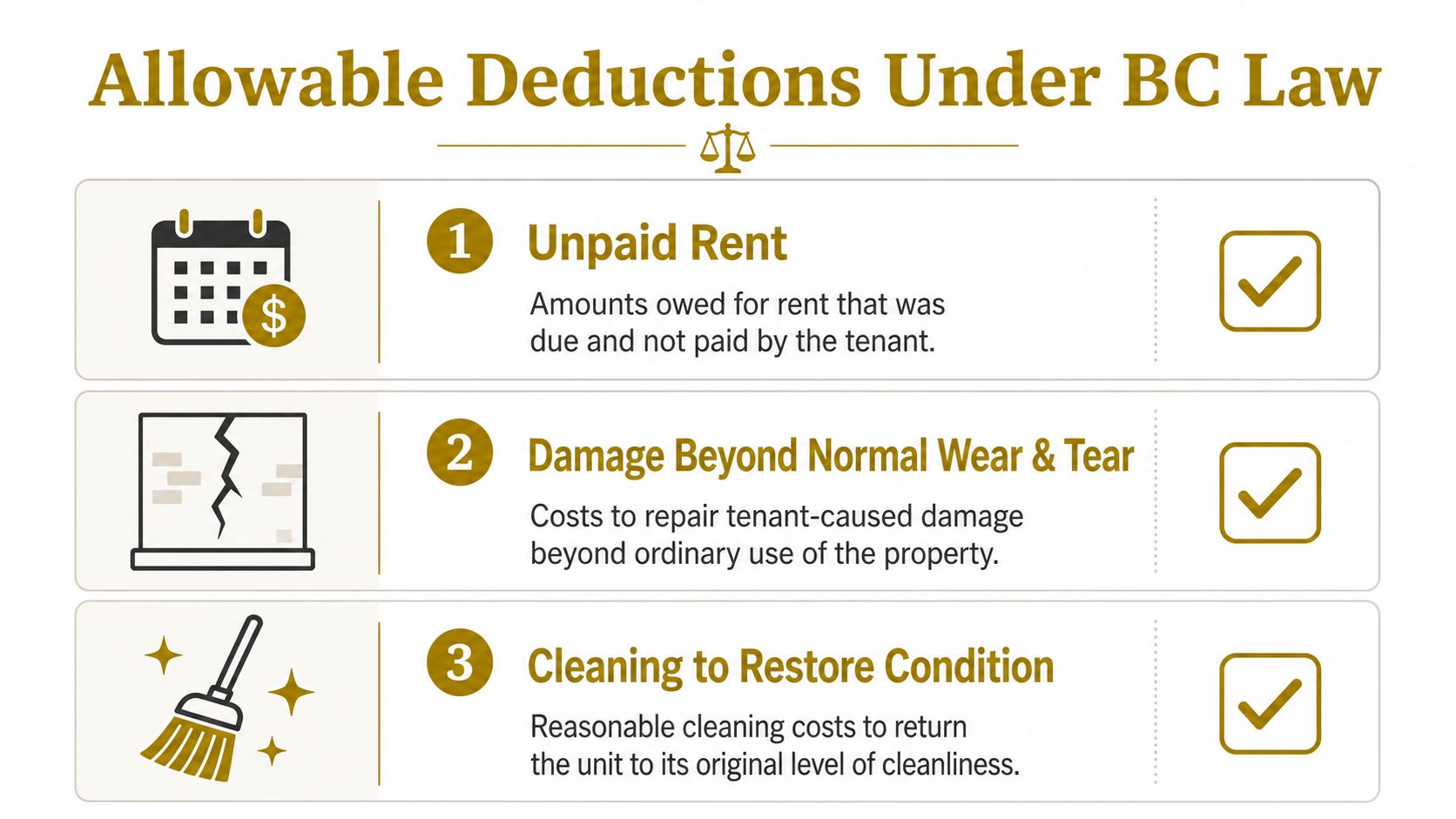
British Columbia allows a landlord to use the deposit for unpaid obligations under the tenancy. In practice, that usually means one of a few things.
- Unpaid rent: If rent was still owing at the end of the tenancy, that balance can be deducted. In a Maple Ridge rental, this often comes up when the last month is short and the deposit covers the missing amount.
- Damage beyond normal wear and tear: This covers tenant-caused damage, not aging. A broken bedroom door in an Albion basement suite or a pet-stained carpet in a West Maple Ridge rental can fit here if the loss goes beyond ordinary use.
- Cleaning to restore the unit to move-in condition: If the home was left dirtier than it was at the start, cleaning can be deducted. A Kanaka Creek townhome that needs professional cleaning after grease on appliances and grime in the bathrooms is a common example.
- Unpaid utility bills the tenant was responsible for: If the tenancy agreement made the tenant responsible for utilities and the bill was left unpaid, that amount can be included in the claim.
The pet damage deposit sits beside the regular deposit, not inside it. A landlord cannot treat it as a general penalty fund for routine turnover, normal wear, or costs that have nothing to do with the animal. If the pet caused the loss and the evidence supports that connection, the pet deposit is the place for that claim.
Good paperwork makes the difference at the end of the tenancy. A repair quote for a damaged door, a cleaner's invoice for post-move-out cleaning, and a hydro statement for unpaid usage put a landlord in a much stronger position than a note that just says “cleaning and repairs.” The same idea shows up in other rental markets too, and a quick comparison with identifying top landlord-friendly states makes BC's tighter rules easier to see without changing how the local law works.
The practical test is simple. If the item is not a tenant obligation, it does not belong on the deposit statement.
The Wear and Tear Line That Decides Almost Every Dispute
Most deposit disputes in Maple Ridge turn on one boundary, damage versus normal wear and tear. That boundary sounds simple until you're standing in a 1970s West Maple Ridge rancher where the paint is dull, the trim is dated, and the carpet has lived a full life, then comparing it with a newer Silver Valley build where the same scratch or stain looks fresh and obvious.
What counts as wear and tear
Normal aging is the landlord's cost of owning a rental. Faded paint, carpet that's worn in the hall, and fixtures that have reached end-of-life are not tenant charges just because the tenancy ended. A dryer that finally gives out after years of service isn't a deposit deduction either, because age isn't tenant damage.
What counts as damage
Damage is different because it comes from negligence, carelessness, accident, or abuse. Large holes in walls, broken windows, torn screens, and pet stains are the kind of things a landlord can usually point to as tenant-caused losses. The same is true when a cracked tile or gouged floor goes beyond what normal use would produce.
The useful-life idea matters here too. A landlord can't usually ask a tenant to pay for full replacement of something that was already near the end of its life just because a problem showed up at move-out. In real terms, that's why a carpet replacement request can fall apart if the carpet was already worn thin before the tenant left. The charge has to match the actual tenant-caused loss, not the whole life of the item.
A proper claim starts with the age and condition of the item before the tenancy ended. Without that baseline, the landlord is often arguing replacement when only repair, or nothing at all, is justified.
A good inspection checklist helps separate these categories before they become arguments. The local move-in and move-out process in Brookside's inspection checklist guide is the kind of thing that keeps the wear-and-tear line visible when memory gets fuzzy months later.
For property managers and owners in Maple Ridge, the practical lesson is that older homes need more context, not more guessing. A scuff in a Silver Valley condo might be obvious damage, while the same mark in a 1970s rental can be lost in the normal ageing of the unit. That's why the inspection file matters more than anyone's opinion at the door.
Building the Paper Trail That Survives an RTB Hearing
A landlord can be right on the facts and still lose if the file is thin. At the RTB table, the strongest claims are the ones that can be shown, not just told, and that starts on day one of the tenancy, not after the keys come back.
The file should begin with the move-in inspection
The move-in condition inspection report is the baseline. It should be signed by both parties and supported by dated photos of each room, appliance, floor, wall, fixture, and any existing flaw. That way, when a stain, crack, or broken blind shows up later, the landlord can point to the comparison instead of relying on memory.
Mid-tenancy records can save the claim later
A check-in walk-through during the tenancy is often where small issues get caught early. A slow leak, a wall scuff from furniture, or a pet habit that's starting to show in the carpet can be documented before the problem grows into a bigger end-of-tenancy dispute. That mid-tenancy file also helps show the landlord acted reasonably and didn't wait until move-out to start building a case.
Receipts and communication matter as much as photos
Keep written notices, texts, emails, quotes, and receipts. If a contractor says the bedroom door needs replacement or a cleaner gives a move-out invoice, those documents do more than prove cost, they prove the landlord didn't invent the amount after the fact. A landlord who can show the tenant was told about a problem during the tenancy usually looks much more credible than one who appears with a pile of unexplained invoices later.
For a useful comparison point on how detail-heavy documentation can be in service work, the piece on documenting customer photos for mobile businesses reinforces the same basic idea, good photos and clear records carry the day when someone challenges the result.

That's also why I tell owners not to rely on casual notes in a phone app with no structure. If the landlord can't produce the move-in report, the move-out report, and the evidence in one clean file, the deduction gets harder to defend. The local process around the RTB 34 form and tenancy disputes is much easier to handle when the paperwork was kept properly from the start.
A Real Maple Ridge Move-Out Calculation
A straightforward example clears up more confusion than any list of rules. Say a Maple Ridge townhouse ends after a two-year tenancy, and the landlord is holding a $2,400 damage deposit. The move-out inspection shows a few real issues, but not a full renovation problem, just a normal end-of-tenancy claim built from separate items.
The key is that each line has to stand on its own. If the carpet needs professional cleaning because of pet stains, that's one item. If the wall patch needs paint touch-up, that's another. If a blind is broken in the living room, that gets its own line too.
| Deduction Item | Amount (CAD) | Reason | Returnable Balance |
|---|---|---|---|
| Carpet cleaning | $600 | Pet stains beyond normal wear | $1,800 |
| Paint touch-up | $350 | Patched wall needed more than a quick repair | $1,450 |
| Broken mini-blind | $90 | Living room blind damaged during tenancy | $1,360 |
| Professional cleaning | $145 | Unit not left in move-in condition | $1,215 |
| Unpaid hydro | $210 | Two weeks of unpaid utility charges | $1,005 |
That leaves $1,005 to return, plus any interest owed on the deposit under BC rules. The number isn't magic, it's the original deposit minus the supported deductions. If one of those line items isn't backed by photos, quotes, or a receipt, the total can shrink fast at an RTB hearing.
The balance also has to make common sense. A landlord can't push a carpet claim beyond what the stain or damage justifies, and a paint touch-up has to reflect the repair, not a whole-room cosmetic upgrade. That's the part many owners get wrong, they price the outcome as if the whole suite is new again, when the law only supports the tenant-caused loss.
If you want a cleaning-focused comparison point, the guide on avoiding tenant deposit disputes shows why a proper end-of-tenancy clean often prevents the simplest arguments. For a practical landlord file, the local tenant move-out checklist is the kind of reference that keeps expectations clear before a dispute starts.
Returning the Deposit and Calculating Interest
The clock starts when the landlord receives the tenant's forwarding address in writing. From that point, the landlord has to act within the required period, either return the deposit with interest, get the tenant's written agreement to the deductions, or apply for dispute resolution to keep any amount. Waiting and hoping the issue sorts itself out is how landlords create avoidable trouble.
Interest on the deposit also has to be paid back when the deposit is returned. The exact calculation is based on the time the deposit was held and the rate set by the Residential Tenancy Branch for that year, so the landlord needs to calculate it before finalising the refund. It's not a goodwill extra, it's part of the amount the tenant is entitled to receive back.
If the tenant gives a forwarding address and then disappears, the safest move is to document that address and send the refund to the last known address rather than hold the money indefinitely. Keep proof of mailing, keep a copy of the statement, and keep the itemised deductions with the file. A landlord who can show they tried to return the funds is always in a better position than one who just left the money sitting in trust.
Practical rule: If the forwarding address arrives in writing, treat the deadline like a hard stop and build the refund package immediately.
The biggest mistake I see is landlords assuming they can sort the numbers later. In BC, that delay is exactly what creates the risk. The deposit process only works smoothly when the paperwork, the timing, and the money all move together.
What Happens When a Tenant Disputes the Deductions
Disputes are normal. A tenant may believe the carpet stain was there already, or that a wall patch is just ordinary paint ageing, and once that happens the RTB process becomes the decision-maker. The landlord files the claim, the tenant gets notice, and both sides put forward their evidence for an arbitrator to review, usually by phone or video.

What tends to win is boring but solid, signed inspection reports, dated photos, contractor quotes, receipts, and a clear chain from move-in to move-out. What tends to lose is a vague claim that the unit was “left messy,” a missing baseline report, or an invoice that appears after the fact with no supporting photos. If a landlord tries to charge full replacement for something that only needed cleaning or patching, the claim often gets trimmed or rejected.
What helps most at the hearing
- Signed reports: A move-in and move-out condition inspection makes the damage timeline much easier to prove.
- Visual proof: Dated photos beat memory, especially when the unit has aged over the tenancy.
- Real cost records: Contractor quotes and receipts show the deduction is tied to an actual expense.
- Clear communication: Emails and texts can show the landlord raised the issue during the tenancy, not just at the end.
The local RTB dispute resolution process guide is worth keeping handy if the file ever gets that far. In practice, the landlord who brings an organised record from a Maple Ridge townhouse, a basement suite, or a family home usually has a fairer shot than the one who shows up with loose notes and a story.
If you're buying, selling, or managing a rental in Maple Ridge and want a property team that understands how tenancy issues affect real ownership decisions, visit Royal LePage Brookside Realty Property Management. We help local owners make better calls on rentals, inspections, and move-outs, and we're always glad to talk through the property side of buying or selling in Maple Ridge and Pitt Meadows.