As of May 1, 2024, British Columbia generally limits short-term rentals in communities with more than 10,000 people to a host's principal residence plus, in some cases, one secondary suite or accessory dwelling unit. If you want to rent for fewer than 90 consecutive days, you also need provincial registration.
That's the reality for a lot of Maple Ridge owners right now. A condo investor in Downtown Maple Ridge, a basement-suite host in Albion, or a detached-home owner in Kanaka Creek can't assume an Airbnb-style model still works the way it did before the rule change. The province rewired the economics, and Maple Ridge is one of the places where that matters most.
Why Maple Ridge Hosts Are Rethinking Short-Term Rentals Right Now
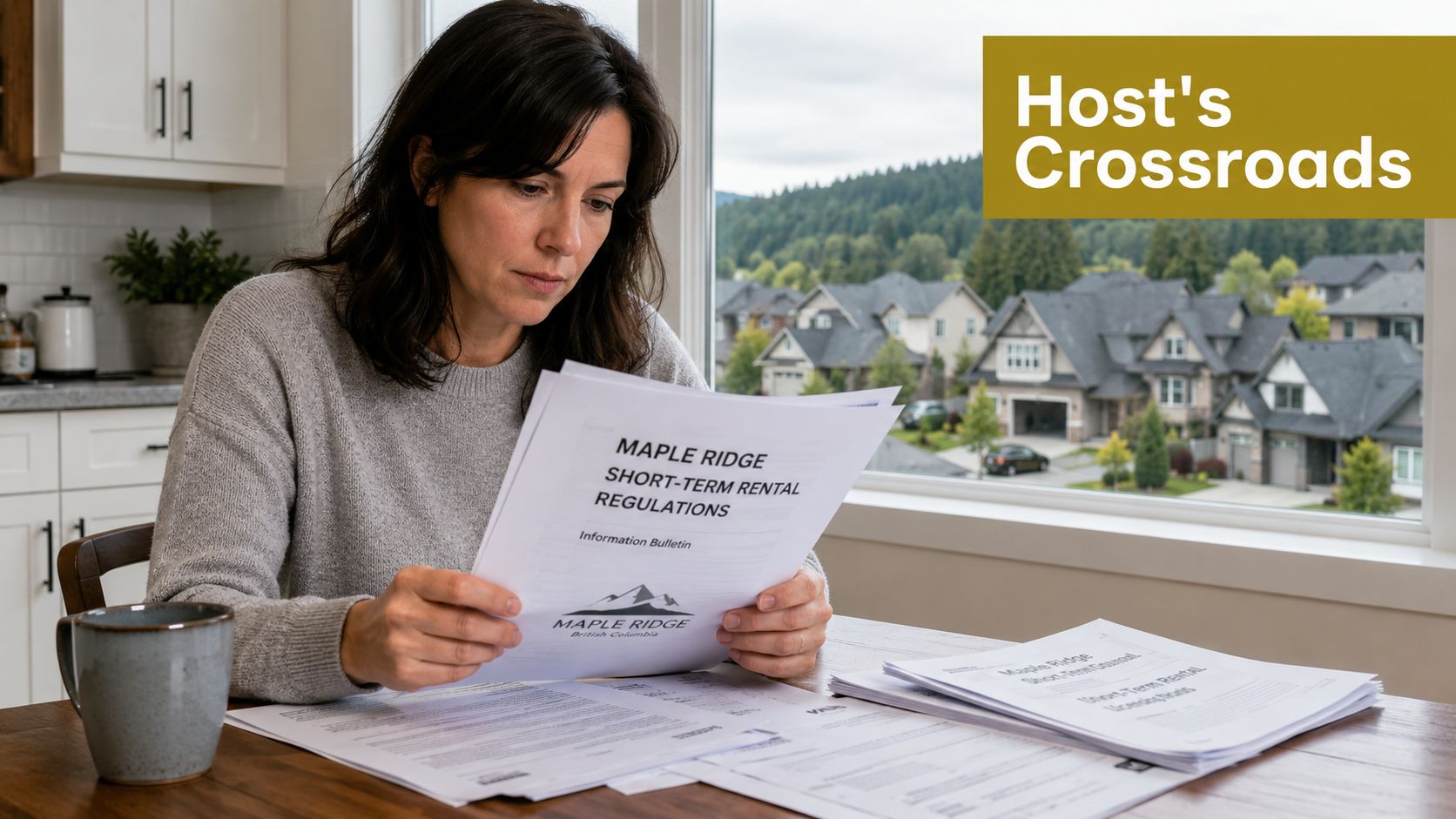
A Maple Ridge owner who used to rely on weekend bookings is now staring at a different spreadsheet. The old assumption, that a second property or an extra suite could earn nightly income, doesn't hold under the new provincial framework. If your unit is not your principal residence, you need to stop treating it like a casual side hustle and start treating it like a regulated business.
The people feeling this first
In Silver Valley, it's the townhome owner who thought a furnished unit could keep paying the strata fee and then some. In Albion, it's the basement-suite host who counted on summer traffic to cover mortgage pressure. In Kanaka Creek, it's the detached-home owner who liked the flexibility of switching between family use and short stays.
The province changed that calculation. Under the Short-Term Rental Accommodations Act, the core direction is simple, most short-term rentals in larger communities now have to be tied to a host's principal residence, with limited room for a secondary suite or accessory dwelling unit on the same property. That's not a technicality. It directly affects whether a property can still be underwritten as a nightly rental or needs to be repositioned as a long-term asset. British Columbia's short-term rental legislation says the law came into force on May 1, 2024 and was built to push non-compliant supply out of the market.
If your deal only works because of nightly income, you need to re-run the numbers now, not after the platform email lands.
The province also reported about 28,000 daily active short-term rental listings in B.C. in 2023, up 20% from the previous year, with more than 16,000 entire homes listed for most of the year. That's exactly the supply type the new rules were meant to squeeze back toward the long-term market. Provincial short-term rental reporting and McGill-led research make clear why the crackdown hit investors first.
For Maple Ridge owners, the practical result is blunt. If you're still pricing a property like it can operate as a year-round nightly rental, your cash flow model is already stale.
How the BC Short-Term Rental Accommodations Act Works
A lot of owners in Maple Ridge and Pitt Meadows still read the province's short-term rental rules as if they were only aimed at downtown condo investors. That is the wrong lens. The law is built around where you live, who can prove it, and whether the property sits inside a covered community.
Start with the home-base test
The Act generally limits short-term rentals in communities with populations of 10,000 or more to a host's principal residence, plus no more than one secondary suite or accessory dwelling unit on the same property. That rule applies across more than 60 communities in B.C., according to provincial reporting. The province's principal residence requirement page sets out the structure plainly, and the province's rollout notice confirms the requirement took effect on May 1, 2024 in those communities. BC's implementation announcement also says hosts must register provincially for rentals of fewer than 90 consecutive days.
That is why a detached investment property in a covered municipality usually stops working as a legal nightly rental the moment you rely on it as a pure income asset. A second property, unless it fits an exemption, is the first thing regulators will question. In this market, that changes the underwriting fast.
Registration is not optional
The 90-consecutive-day threshold matters because it triggers provincial registration. If you rent for fewer than 90 consecutive days, you are in the registration system whether you like it or not. That is not admin fluff. It is part of how the province tracks supply and forces platforms to deal with compliance.
The province tied registration to platform accountability and data-sharing, which is why unregistered listings can be pushed out faster than they ever were under older local-only systems. Hosts should treat that as an enforcement warning, not a paperwork note. A recent case involving a property manager facing a $27,000 fine for short-term rental fraud shows how hard the province is willing to come down on bad actors, and it is worth reading our analysis of that investigation, B.C. property manager faces $27,000 fine amid short-term rental fraud investigation.
What actually qualifies
The carve-out for a secondary suite or accessory dwelling unit only helps if the main residence test is already satisfied. The province is allowing a homeowner to host from the home they live in, and in some cases from one additional unit on the same property. It is not a blank cheque to run a separate investment condo like a hotel rooming house.
For Maple Ridge and Pitt Meadows owners, the practical test is simple. Would you still qualify if the province asked you to prove this is your real home? If that answer is weak, the unit is probably not legal under the provincial framework, and the rest of your cash flow model needs to be rebuilt around that reality.
Maple Ridge Bylaws vs the Surrounding Metro Vancouver Market
Maple Ridge is not Vancouver, and that's the point. Local rules here lean practical and operational, not tourist-district theatrical. The city requires a business licence before listing or advertising, defines a short-term rental as overnight accommodation of no longer than 30 consecutive days, and its proposed regulations include a maximum of 6 guests, one whole-unit listing per property, up to three bedrooms if renting by bedroom, and one off-street parking space per listing. Maple Ridge's short-term rental page shows a city trying to control nuisance, parking, and overcrowding, not just tax collection.
What that means for strategy
A host trying to mimic a downtown Vancouver model will probably be disappointed. Vancouver is more mature on enforcement and business licensing, while Maple Ridge's proposed framework is narrower in the ways that matter on the ground, especially parking and guest count. Surrey and Burnaby each bring their own local enforcement styles, but the strategic lesson is the same, provincial eligibility is only the starting point, and municipal rules decide whether the property is viable as a guest unit.
| Rule Lever | Maple Ridge (Proposed) | Typical Metro Vancouver City |
|---|---|---|
| Business licence | Required before listing or advertising | Often required, with strict display rules |
| Stay length definition | Overnight accommodation up to 30 consecutive days | Usually uses its own short-term rental definition and permit framework |
| Guest cap | Maximum of 6 guests | Often limits occupancy through licence conditions |
| Whole-unit use | One whole-unit listing per property | Frequently limited to principal residence use |
| Bedroom-by-bedroom rental | Up to three bedrooms | Usually more tightly controlled through local rules |
| Parking | One off-street space per listing | Parking is often handled through site-specific conditions |
Maple Ridge gets interesting for investors. The city's rules make the model more manageable for a homeowner, but less attractive for anyone trying to run a portfolio-style nightly rental business. That is not a flaw. It's a signal.
If your return depends on squeezing maximum turnover out of a property, the local framework pushes you toward a different model. If your goal is to monetise a principal residence or a legal suite with clean, predictable operations, Maple Ridge is more workable than a lot of people assume.
Strata, Licensing, and Registration Layers That Actually Gate Your Listing
A lot of owners get this backwards. They start with the city, then provincial registration, then wonder why a strata notice blows up the whole plan. The order matters. Strata rules can shut you down even if the province says you qualify.
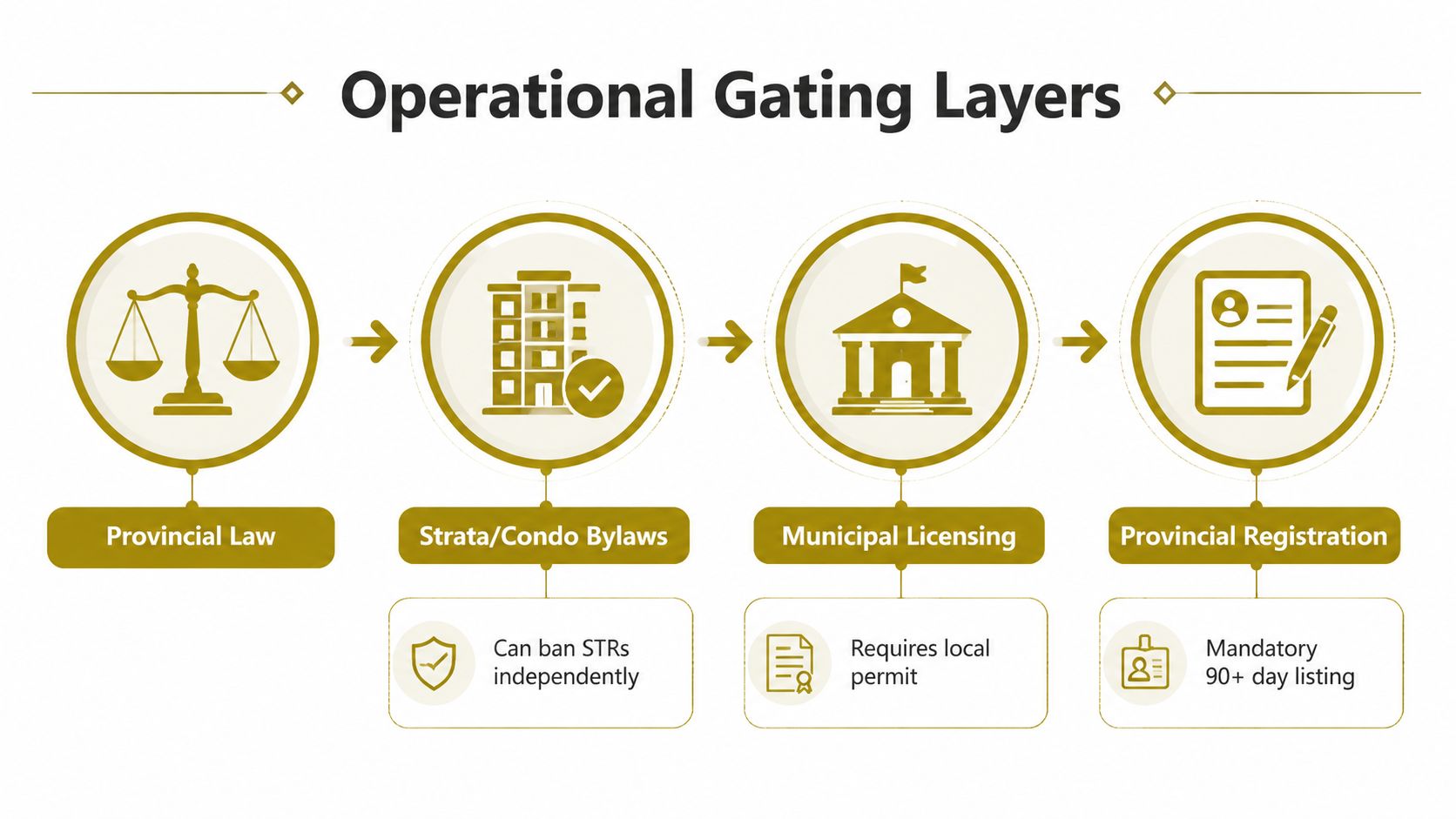
The three gates you have to clear
First, check the property against provincial law. If it's not your principal residence, or it doesn't fit the secondary-suite carve-out, you're likely out.
Second, read the strata documents or building rules. A building can ban short-term rentals outright. That means a unit can be provincially eligible and still be dead on arrival inside the building. A compliant host who ignores a strata ban is not “close enough”, they're exposed.
Third, deal with local licensing and registration. Maple Ridge requires a business licence, and the province requires registration for rentals under 90 consecutive days. Those are separate gates, not duplicates. The province does not replace the municipality, and the municipality does not replace the province.
Practical rule: If one layer says no, the listing stops there. Don't spend money on décor, photography, or cleaners until the building and licence file are both clean.
This is why an Albion basement-suite scenario can still fail even when the homeowner meets provincial criteria. The host may live in the home, may satisfy the principal residence test, and may even be willing to register. If the strata or building policy is outdated and still bans short-term rentals, the suite still can't operate.
The brokerage value in this market is understanding the sequence before the money gets spent. That's where owners lose time and confidence. Strata property management guidance is useful here because the building rules often become the primary gatekeeper, not the platform listing itself.
Treat the checklist as a legal chain. Miss one link, and the whole revenue model breaks.
Taxes That Stack on Top of Every Booked Night
Nightly income looks cleaner on a listing page than it does in a ledger. Each booked stay carries tax friction, and that friction matters more in Maple Ridge than most owners expect because the gross rate needs to survive a stack of charges before it becomes real cash flow.
The cost stack
The first layer is the 5% federal GST. On top of that, B.C. applies PST on related services where applicable, and many properties in the broader Fraser Valley face MRDT of 2% or 3% depending on the local regime. Some places also talk about a municipal accommodation levy or bed tax, which can add another layer if adopted. If you are operating direct bookings, these items need to be built into the nightly rate, not guessed at after the fact.
A simple example shows the pressure. If a Maple Ridge host charges a nightly rate and also has cleaning or related service charges, the gross booking amount can get chipped away by GST, provincial tax treatment, and local accommodation taxes before the owner ever sees net income. That is why a property that looks profitable on an Airbnb calendar can underperform once the tax stack and operating costs are applied.
Underwriting changes fast
The better question is not whether nightly stays can earn more than a long-term tenant. It's whether they still earn enough after taxes, vacancy gaps, furnishing costs, deep cleaning, utilities, and compliance overhead. In a market like Maple Ridge, that gap narrows quickly if the calendar is inconsistent.
If you want a practical rundown on deductible items and tax positioning, the tax savings for vacation rentals article is a useful companion. Pair that with your own records and the rental property tax deductions discussion, because the core issue is not just what you collect, it's what survives after every required layer is paid.
A lot of owners chase gross revenue and ignore net yield. In this market, that mistake is expensive.
My advice is simple. If your nightly rate only works when the calendar is fully booked and the tax stack is ignored, the model is too fragile for Maple Ridge. Move the property into a long-term tenancy or a furnished longer-stay strategy before the numbers force the decision for you.
Safety, Insurance, and Enforcement You Cannot Afford to Skip
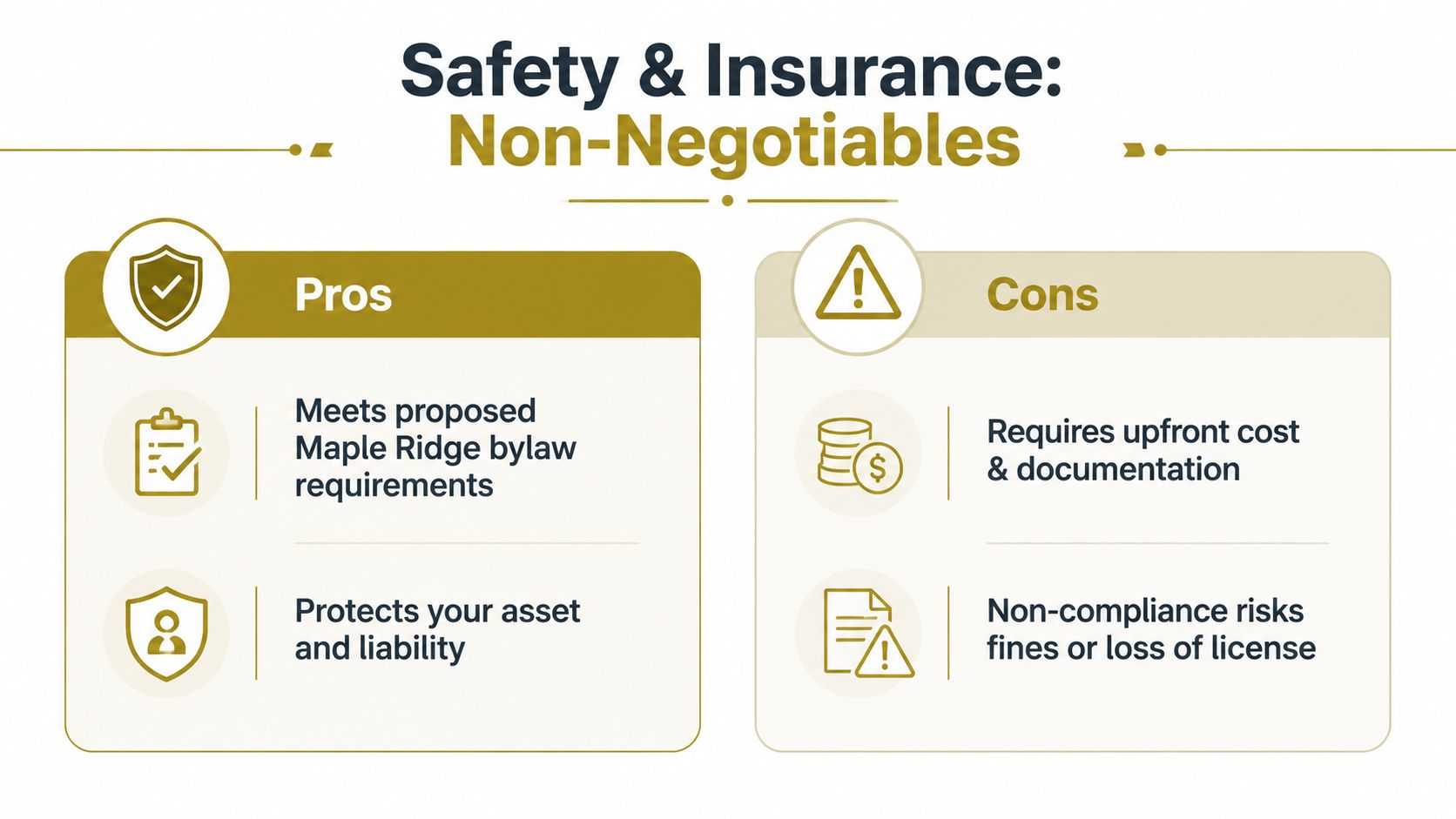
Safety and insurance are not box-ticking exercises. They are the difference between a manageable host operation and a file the city, insurer, or platform can shut down fast. If you're still treating guest stays like ordinary homeowner use, you're underestimating the risk.
What Maple Ridge is signalling
Maple Ridge's proposed bylaws point to smoke and carbon monoxide alarms, fire safety, and occupancy controls. That aligns with what most experienced hosts already know, guest stays create a different liability profile than ordinary residential living. The city wants predictable occupancy and basic life-safety controls, not improvisation.
Insurance is the part most owners underestimate. A standard homeowner policy usually doesn't cover paid guest stays the way a short-term rental operation needs it to. If you don't disclose the hosting use, you may think you're insured right up until a claim gets challenged. That is not a theoretical problem, it's a balance-sheet problem.
For a more detailed insurance lens, the insurance rules for contractors article is useful because it shows how coverage questions change when a property is used for commercial or semi-commercial activity. Rental property insurance coverage is the right place to go next if you're comparing ordinary rental protection with guest-stay risk.
Enforcement is now part of the model
The province strengthened enforcement with registration and platform data-sharing, which means non-compliant supply is easier to identify and harder to hide. That matters because the penalty isn't just a fine. Delisting can cut off the entire revenue stream.
If the platform drops your listing, your calendar doesn't matter anymore.
That is why cutting corners on alarms, occupancy, or insurance is a bad bet. It can turn a revenue problem into a forced shutdown. In Maple Ridge, where the business licence and local operating rules already sit on top of provincial law, the fastest way to lose money is to assume enforcement will move slowly.
My view is blunt. Install the safety gear, document it, notify your insurer, and keep every file clean. Anything less is gambling with the asset.
Your Maple Ridge STR Compliance Checklist
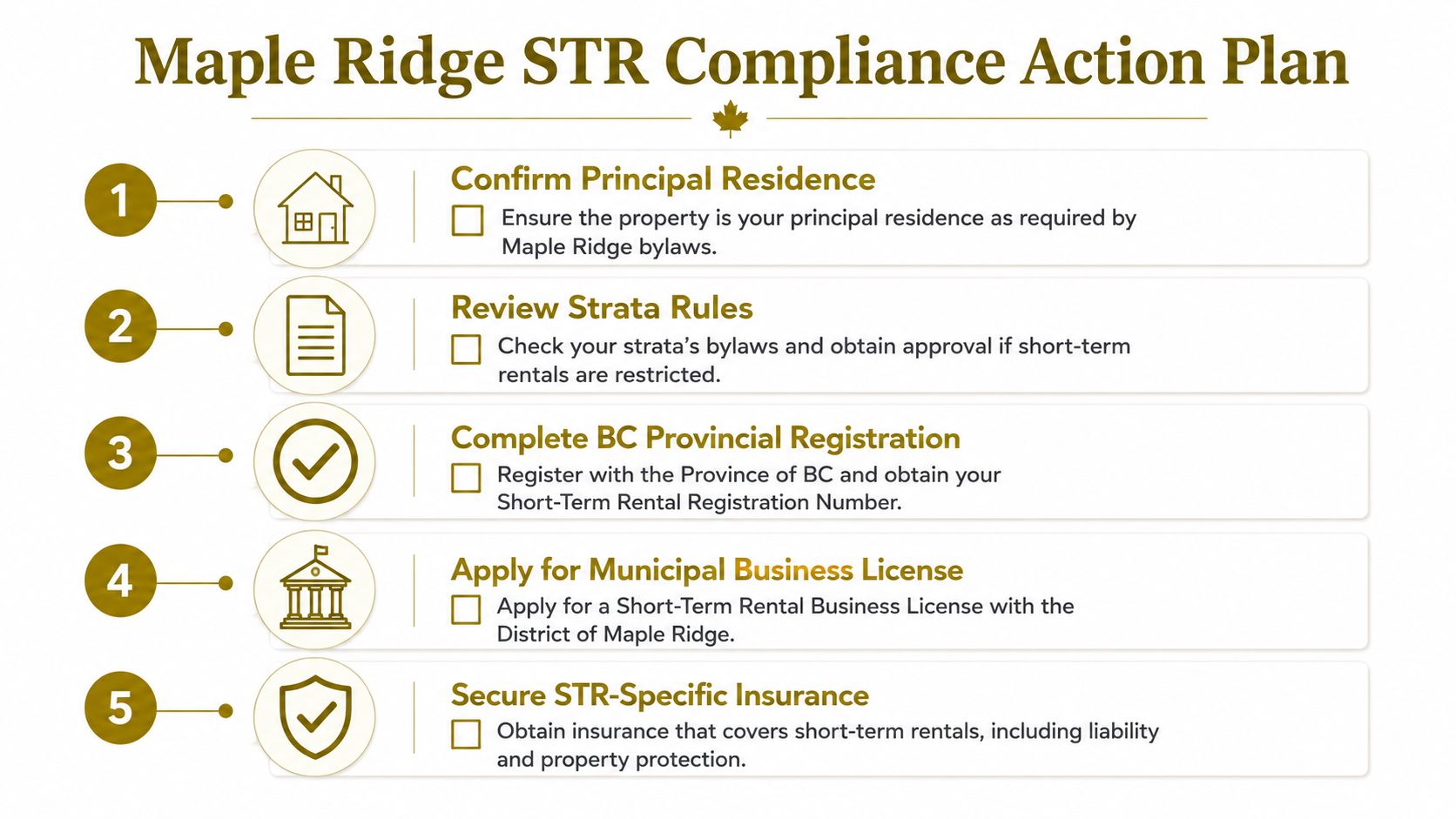
Start with the property, not the listing site. Confirm whether the home is your principal residence, because that's the provincial gate that determines whether the unit even belongs in the short-term rental conversation.
A simple order that works
- Confirm principal residence status. If the property is not your real home, stop and re-evaluate the model.
- Review strata rules or building bylaws. A building ban overrides your enthusiasm fast.
- Complete BC provincial registration. This is required for stays under 90 consecutive days.
- Apply for the Maple Ridge business licence. Don't advertise before this is in place.
- Set up tax collection and remittance. Your nightly rate has to survive GST, PST treatment, and any local accommodation tax exposure.
- Install safety devices and document them. Smoke and carbon monoxide alarms should be obvious, not optional.
- Notify your insurer. Don't wait for a claim to discover the policy excludes guest stays.
If you want a clean operating routine, the essential property management checklist steps article is worth keeping nearby. It pairs well with the compliance layers here because short-term rental success now depends on process, not optimism.
If the property no longer pencils out as a nightly rental, don't cling to the old model. Rework it as a 90-plus-day furnished rental, shift to a conventional long-term lease, or consider a strategic sale while the Maple Ridge market still matches your equity goals. If you're weighing that decision, talk to a local team that understands how these rules affect pricing, timing, and buyer demand in Maple Ridge and Pitt Meadows.
Royal LePage Brookside Realty Property Management helps owners in Maple Ridge and Pitt Meadows make practical decisions when rules, cash flow, and property strategy stop lining up. If you're deciding whether to hold, rent long term, or sell, visit Royal LePage Brookside Realty Property Management to talk through the right next move for your property.