You know the feeling when you pull into a neighbourhood on a Saturday, slow down for the first roundabout, and start asking the tough questions. Does this feel like the Maple Ridge you pictured, or is it something a little newer, quieter, and more stitched-together around school runs, garages, and cul-de-sacs? That's usually the moment Albion either clicks or doesn't, and living in Albion Maple Ridge comes down to more than the listing photos.
Albion sits in a younger, more family-heavy pocket of Maple Ridge, and that matters if you're trying to decide whether the streets, homes, and pace of life fit your day-to-day rhythm. The neighbourhood's profile, market behaviour, and practical trade-offs are all a little different from older parts of town, so the right question isn't just whether it's nice, it's whether it works for your budget, commute, and long-term plan.
Why Albion Feels Different From the Rest of Maple Ridge
A couple touring Albion on a Saturday usually notices it fast. The roads feel newer, the homes sit on cleaner lines, and the whole area has that suburban, move-in-ready feel that comes with a neighbourhood built around family routines rather than older in-town character.
Who lives here shapes how it feels
That impression lines up with the local profile. AreaVibes reports 12,424 residents, a population density of 692 people per square kilometre, and a median age of 37.1 in Albion, compared with Maple Ridge overall at 40.9 and 334 people per square kilometre respectively, which points to a denser and younger community AreaVibes Albion demographics. The same source says 58% of Albion households have kids at home, versus 48% in Maple Ridge and 41% across British Columbia, while 76% of households are married couples compared with 70% in Maple Ridge and 71% in the province AreaVibes Albion demographics.
English is the only language spoken in 92.6% of households, and the most common visible-minority groups include South Asian at 3.4% and Chinese at 3.3% AreaVibes Albion demographics. For buyers, that doesn't mean the neighbourhood is one-note. It does mean Albion tends to read as stable, owner-focused, and family-oriented rather than transient or rental-heavy.
Practical read: If you want weekend quiet, predictable streets, and a lot of homes that feel occupied by owners who plan to stay, Albion will likely make sense. If you want a busier, more mixed-use feel, it may feel too residential.
Where it sits and why that matters
Albion's northeast Maple Ridge location gives it a different daily pattern from central neighbourhoods. Lougheed Highway and 102 Avenue shape how people move in and out, and the routes toward Pitt Meadows and the Tri-Cities matter just as much as the neighbourhood itself if you commute or split your week between home and office.
That location can be a strength for families who want a suburban base without losing access to the rest of the region. It can also be the reason a buyer rules it out after one test drive, because the neighbourhood reward is square footage and newer housing, not an especially short trip into the city.
Types of homes Maple Ridge buyers guide
Housing Stock and What You Can Buy in Albion
Albion does not present buyers with one neat housing story. The neighbourhood is still dominated by single-detached homes, and much of the stock was built after 2000, so a lot of what you see is newer construction rather than older resale product with years of deferred maintenance Royal LePage Albion properties. That matters if you are comparing Albion with older Maple Ridge pockets where the search often turns into a renovation exercise before you even get to the offer table.
What the product mix means in practice
The ownership profile is part of why Albion feels settled. About 90% of units are owner-occupied and about 10% are rented, which usually means more consistent upkeep and fewer investor-driven swings in day-to-day occupancy Royal LePage Albion properties. It also means there are fewer rental choices and less turnover for buyers who are hoping to see the neighbourhood through a landlord-heavy lens.
Detached homes still take up most of the active inventory, and that is where Albion's pricing pressure shows up first. Townhouses do come up, and they matter because they give some buyers a way into the neighbourhood without jumping straight to detached-house pricing. Condos and row homes are a smaller part of the mix, so buyers need to treat availability as limited rather than assume every format appears in equal measure.
Albion works best if you shop by product type first. A townhouse buyer and a detached-home buyer are not looking at the same market, and the trade-offs are different for maintenance, strata exposure, and resale.
If you are comparing home styles across Maple Ridge, it helps to understand how lot size, strata rules, and age of construction change the ownership experience. A useful background read is Maple Ridge home types for buyers, especially if you are deciding whether to stretch into a detached home or stay with a lower-maintenance format. For owners who are budgeting around older systems in a resale house, the repair side matters too, and Vancouver Poly B pipe costs is worth reviewing before you assume a property is turnkey.
Albion suits buyers who want newer suburban housing and a cleaner resale profile, but it does not give the same breadth of heritage character, compact strata choice, or older inventory that you find in other Maple Ridge areas. Walk the listings with that in mind. A lot of the decision here is about function, maintenance load, and how much house you want to carry, not just the number of bedrooms on paper.
Albion Home Prices and What They Mean for Your Budget
A buyer can feel the budget pressure in Albion almost immediately. Current market snapshots put the average Albion home sale price at $1,182,799 and the average listing price at $1,746,000, which sits about 15% above the average home price in Maple Ridge Zolo Albion market snapshot. Another local guide places Albion's average home price at more than $1,100,000 and describes it as close to 20% above the standard Maple Ridge average The Local Living Albion guide. If you are comparing Albion against the rest of the city, Maple Ridge home prices explained is a useful way to frame that gap in practical terms.
The split between townhouse and detached pricing
The budget divide shows up by property type. One neighbourhood guide puts townhouses at about $850,000 to $1,050,000, while detached homes are often priced around $1.45 million to $1.85 million depending on lot size and home type Bronson Job Albion guide. That spread changes the conversation fast. It is the difference between buying into the neighbourhood with a lower carrying cost and buying land, privacy, and more control over the property.
A townhouse buyer is usually balancing entry price, strata rules, and lower maintenance. A detached buyer is paying for land, privacy, and more room to make changes without strata approval. Those are different ownership models, even if the postal code is the same.
| Albion Housing and Price Snapshot | Typical Price Band | Active Inventory (approx.) |
|---|---|---|
| Townhouse | $850,000 to $1,050,000 Bronson Job Albion guide | 17 townhomes Zolo Albion market snapshot |
| Detached home | $1.45 million to $1.85 million Bronson Job Albion guide | 43 detached houses Zolo Albion market snapshot |
| Broader active market | Average listing around $1,746,000 Zolo Albion market snapshot | 62 homes for sale Zolo Albion market snapshot |
Budgeting in Albion also means pricing in the condition side of the house, not just the asking price. Newer homes still need a proper inspection, and older resale properties can carry repair exposure that does not show up in the listing photos. If a home has any plumbing or service-line concerns, it is smarter to factor that in before you write an offer. For a practical reference on what that can mean, Vancouver Poly B pipe costs helps explain why a surprise inspection item can change the total cost of ownership.
Market Conditions, Days on Market, and How to Read Them
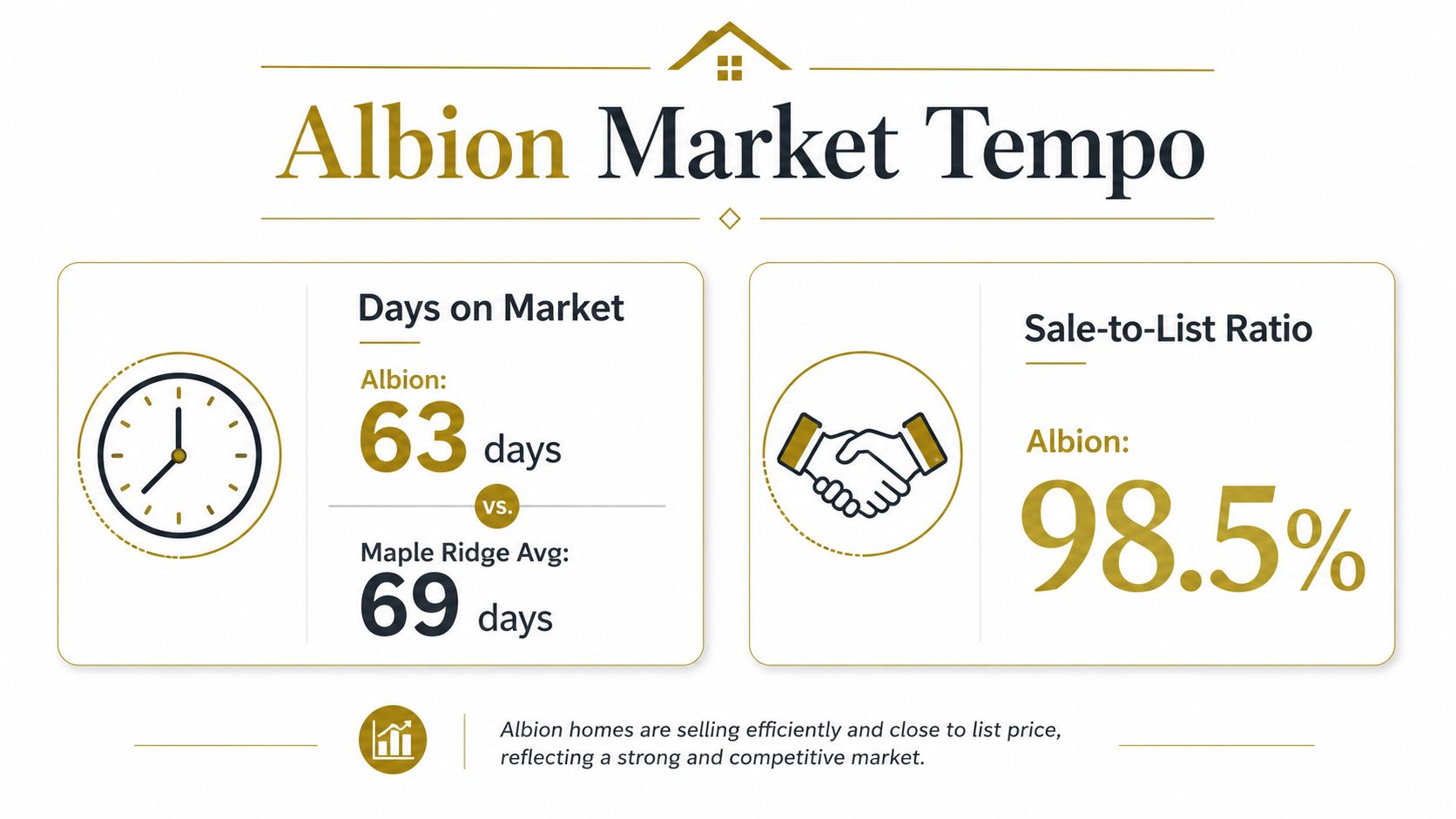
Albion's market keeps moving, but it does not behave like a place where every clean listing vanishes the same day. Recent snapshots show homes taking a couple of months to sell on average, while still closing very close to asking. That combination matters. It tells you buyers are active, but they are still selective, and they have enough patience to compare condition, location, and price before committing.
What those numbers tell buyers and sellers
The spread between listing price and sale price is the part to watch. In Albion, inflated pricing does not usually get rewarded for long, and buyers know how to spot a home that is leaning on optimism instead of evidence. For current market context, the June 2026 Metro Vancouver housing market trends update helps explain why well-presented homes still draw attention while overreaching listings lose momentum.
Buyers should read the pace in two ways. There is enough activity to create competition on the right home, especially if it is clean, well staged, and sensibly priced. At the same time, condition still matters enough that a tired listing, an awkward layout, or visible deferred maintenance can slow buyer interest even in a neighbourhood with steady demand.
In Albion, the list price is only the starting point. The key question is whether the home presents cleanly enough to justify the number, and whether the seller has priced for the neighbourhood, not for wishful thinking.
Sellers need to approach the market with discipline. A strong launch, accurate pricing, and presentation that shows the home has been cared for can change how buyers respond in the first few days. A listing that feels neglected, or one that asks too much for what it offers, tends to sit and invite tougher questions.
Schools, Parks, and Family Life in Albion
Families usually ask about schools first, and that makes sense. In Albion, the daily family experience is shaped by the same things that draw people here in the first place, including newer housing, sidewalks, green connections, and a community feel that suits kids coming and going on bikes and foot rather than by car all the time.

The part families like
The neighbourhood's planning emphasis on connectivity, walking, and cycling is part of its appeal, and so are the recreation-oriented pieces that make a suburb feel lived in rather than just built out. Albion Community Centre is a real anchor, not a decorative one, because families use these places for routine, not for special occasions.
The area also functions as a place where weekend life can stay fairly local. That matters when you're juggling sports, drop-offs, groceries, and the ordinary chaos that comes with younger households.
The harder conversation
Recent local coverage has flagged a genuine concern, residential growth in Albion is outpacing nearby school capacity, and councillors have warned that future Albion developments lack educational facilities in proximity Read the Ridge on Albion developments and schools. That doesn't make the neighbourhood a poor family choice. It does mean you need to look harder at assignment, capacity, and transportation than you might in a slower-growing pocket.
If you're comparing family neighbourhoods, Silver Valley versus Albion for growing families is worth a look because the school and service trade-offs are a key part of the decision.
Before you buy, confirm these points:
- School assignment: Verify the current catchment, not just what an older listing description says.
- Capacity pressure: Ask how nearby schools are handling growth and whether overflow patterns affect your family.
- Daily logistics: Check whether pickup and drop-off, walking routes, and transit feel workable in practice.
- After-school life: Look at how far kids need to go for sports, recreation, and activities once the school day ends.
Albion can work very well for families, but the best fit comes from verifying the infrastructure around the home, not just admiring the house itself.
Commuting From Albion to Vancouver and the Tri-Cities
Commute reality is where a lot of Albion decisions are won or lost. Buyers often love the house, then start measuring the route to work, daycare, and after-school pick-ups, and that's where the neighbourhood either feels manageable or too far out.
The driving picture
Lougheed Highway is the obvious spine, and the Mary Hill bypass matters if your week takes you toward Coquitlam, Port Moody, or Vancouver. Off-peak, those corridors can feel very different from peak travel, and anyone making the drive regularly should test the route at the time they'd be on the road.
That's the practical part many listings gloss over. Albion gives you room, but it asks for more time in the car, especially if your job is still in the city core or if your family's schedule runs on tight pickup windows.
Transit and backup options
Transit users should keep expectations grounded. HandyDART, local bus routes, and Maple Ridge's West Coast Express station can help, but they don't turn Albion into an inner-suburb commute SkyTrain and transit context for Maple Ridge. The right question is whether the mix of transit and driving still makes life workable on a bad-weather day, a late meeting, or a kid with an evening activity.
If your work is split between Vancouver and the Tri-Cities, Albion can make sense as a value play, but only if the commute cost feels acceptable on ordinary weeks, not just on the easiest one.
Buyer Risks Most Albion Coverage Skips Over
Most Albion marketing leads with family-friendly streets and newer homes. That's useful, but it skips the part buyers lose sleep over once they've found the right house. Location-specific risk can affect insurance, financing, and resale, and Albion deserves the same hard-nosed due diligence you'd use anywhere else in Maple Ridge.

The risks that deserve a closer look
A Maple Ridge buyer-safety briefing specifically flags Port Hammond, Kanaka Creek, and Pitt River floodplain areas, plus steep slopes in Albion and Silver Valley, and the need to check for underground tanks and drug-affected homes Maple Ridge buyer-safety briefing. That's the kind of information that changes a buyer's strategy before subjects are removed.
Riparian setbacks and wildfire interface risk matter for the same reason. They can affect what a lender is comfortable with, what an insurer will cover, and how confident the next buyer will feel when it's time to resell. A home can look immaculate and still carry more practical risk than a property that appears less polished.
Rule of thumb: If a property looks straightforward but sits near a slope, water interface, or older utility history, get the paperwork checked before you fall in love with the finishes.
For buyers, the checklist is simple:
- Order the right inspections: Don't assume newer construction means risk-free construction.
- Ask about hidden history: Tanks, prior use, and remediation status matter.
- Confirm insurance terms early: Wait too long and you can get surprised.
- Read the location, not just the house: Albion is a neighbourhood where the site itself can matter as much as the floor plan.
That's the difference between a comfortable purchase and an expensive lesson.
Pros, Cons, and Smart Next Steps for Buyers, Sellers, and Owners
Albion makes sense for buyers who want newer housing, a family-heavy streetscape, and a neighbourhood that feels settled rather than experimental. It loses points for people who need a short commute, want a wide range of home types, or don't want to think hard about school capacity, slope, and floodplain-related due diligence.
For move-up buyers
If you're moving up from a smaller home elsewhere in Maple Ridge, Albion is worth comparing against older pockets on a straight value basis, not a lifestyle fantasy. You're paying for newer construction and a family-oriented setting, so the question is whether that premium buys you the layout and routine you want.
For sellers
Pricing and presentation matter here because the market still measures homes carefully, with average days on market in the low-to-mid 60s and sale-to-list ratios that reward realism Zolo Albion market snapshot. A home that shows cleanly, photographs well, and lands in the right range will usually outperform one that leans on neighbourhood reputation alone.
For owners and investors
If you own a property here and are thinking about renting it out, professional support can help with leasing, screening, maintenance, and rental assessment. Royal LePage Brookside Realty Property Management is one local option for those services, especially if you want help translating Albion's owner-occupied profile into a practical rental strategy.
Albion is a strong neighbourhood when the fit is right. It rewards buyers who value stability, sellers who price with discipline, and owners who treat due diligence as part of the purchase, not an afterthought.
If you're weighing a move, a sale, or a rental plan in Albion, talk it through with a local Maple Ridge team that knows how the market behaves on the street, not just in the listing remarks.
If you're considering a purchase, sale, or rental strategy in Maple Ridge, Royal LePage Brookside Realty Property Management can help you sort through pricing, tenant placement, maintenance, and local market decisions with a practical lens. Albion rewards careful planning, and a clear conversation now can save you from costly surprises later.